
OTIF is a strict pass/fail score. An order only counts if it’s on time and in full. If you miss either one, it fails.
Ship 100 orders, 88 land on time & complete → 88% OTIF. The other 12 were late, short, or both.
OTIF, which stands for On-Time, In-Full, is an important supply chain metric. It checks whether an order arrived when it was supposed to and with the right items and quantities. Many use it to spot service gaps, track fulfillment performance, and catch issues before they turn into repeat complaints.
How does OTIF work and how can you use it to improve your supply chain?
We’ll show you how with this guide where we break down what OTIF means, how it’s measured, and some best practices you can do to retain that good benchmark.
What This Page Covers
Everything you need to know about OTIF at a glance.
- OTIF measures whether orders arrive on time and in full. Both conditions must be met at the same time to count as a pass.
- OTIF scores depend on clear definitions. This includes what counts as “on time,” “in full,” and how each order gets measured.
- A good OTIF target varies by industry, shipping model, and customer requirements. Benchmarks work best as a guide, not a hard rule.
- Low OTIF is usually caused by gaps. Common ones show up in planning, inventory, warehouse work, transportation, or reporting rules.
- OTIF improves faster when teams track misses consistently. Fix the biggest root causes first, then expand from there.
Reliable Fulfillment You Can Measure
- Real-time tracking so teams can follow orders start to finish
- Reach 94% of the U.S. within 2–3 days via ground shipment
- Monthly inventory reports with account manager reviews
- Works with Shopify, WooCommerce, Amazon, and more

COMMERCE Get a Quote
What Is OTIF?
OTIF (On Time, In Full) is a supply chain metric used to check if an order arrived by the agreed delivery time and with the correct items and quantities.
The metric has two parts, and both must be met for an order to count as OTIF. If an order arrives on time but is missing units, it does not pass. If it arrives complete but late, it also does not pass.
To put it simply, the entire concept is that orders have to be delivered on time and in full.
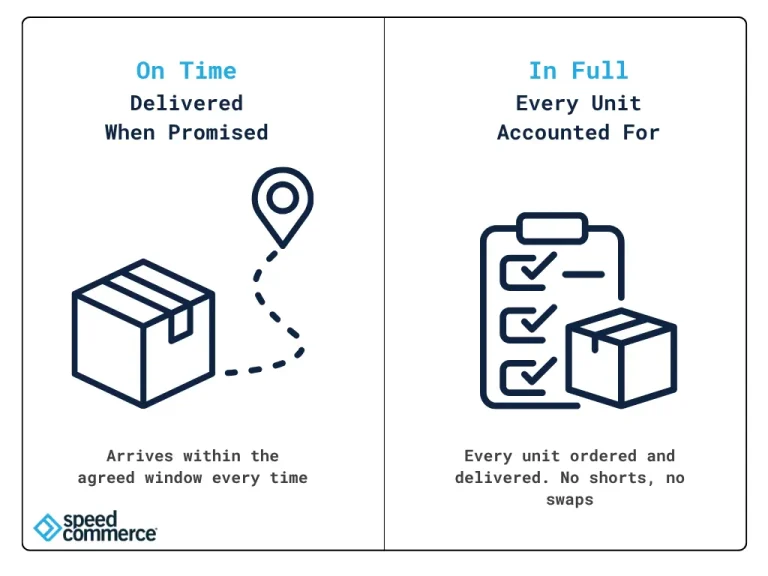
A lot of reputable companies use OTIF to measure delivery performance in a clear and consistent way, such as Walmart and Proctor and Gamble. It helps flag any service gaps, track fulfillment reliability, and spot patterns that can lead to delays, short shipments, or repeat customer issues.
Apart from that, OTIF also shows you where service breaks down or which part of the supply chain is creating the misses most often. A late delivery can point to timing problems in picking, staging, carrier pickup, or transit. While a short shipment often points to stock accuracy, picking errors, or planning gaps.
In a study done by McKinsey, they found that about 92% of major retailers and manufacturers in North America agree that having an industry standard for OTIF is beneficial to improve collaboration, reduce disputes, and create value across the supply chain.
How Companies Measure OTIF
Do you measure OTIF?
- 78% Measure both on-time and in-full together
- 17% Measure on-time and in-full separately
- 4% Don’t measure OTIF at all
How Is On-Time Measured?
Preferred Fill Rate Method
Where On-Time Performance Is Lost
All figures based on McKinsey’s 2019 report on OTIF in the consumer sector.
How Is OTIF Calculated?
OTIF Formula
As mentioned before, there are two conditions that must be met: on time and in full.
OTIF’s formula is usually calculated as such:
Say you shipped 100 orders in one month.
The rule here is strict. An order only counts if it meets both parts. If it misses one part, it does not count toward OTIF.
If you want to know your OTIF score (and how to improve), you can try out our calculator.
OTIF Calculator
Measure your On-Time In-Full performance and get improvement tips.
What exactly counts as on time and in full? There is no universal OTIF definition in place. How a company counts as on time or in full depends entirely upon them.
What Counts As On Time?
A lot of companies have their own criteria for defining “on-time” packages, but it’s usually counted when it arrives on the agreed delivery date, within the agreed delivery window (if a time window is used), or based on the appointed time and date agreed upon.
Does Early Delivery Count?
Sometimes, yes, sometimes no.
Some companies accept early deliveries. Others do not, especially if a warehouse uses scheduled receiving windows. If a shipment arrives too early and cannot be received, it might still fail the “on time” requirement.
Which Delivery Time Should Be Used?
This is important because if you can’t agree on what event counts as the delivery timestamp, your OTIF reports can become inconsistent. You can choose either:
- Arrival at the facility
- Check-in at the dock
- Proof of delivery scan
- Completed unload time
What Counts As In Full?
An order is usually counted as in full when it has the correct SKU or product, the correct quantity, no missing units, and no unauthorized substitutions.
If any part of the order is short, split incorrectly, or missing any items, it usually fails this criteria. Same goes for damages. For example, if the full quantity arrives but some units are damaged and rejected, the order may not count as “in full.”
How OTIF Misses Disrupt Supply Chain Operations
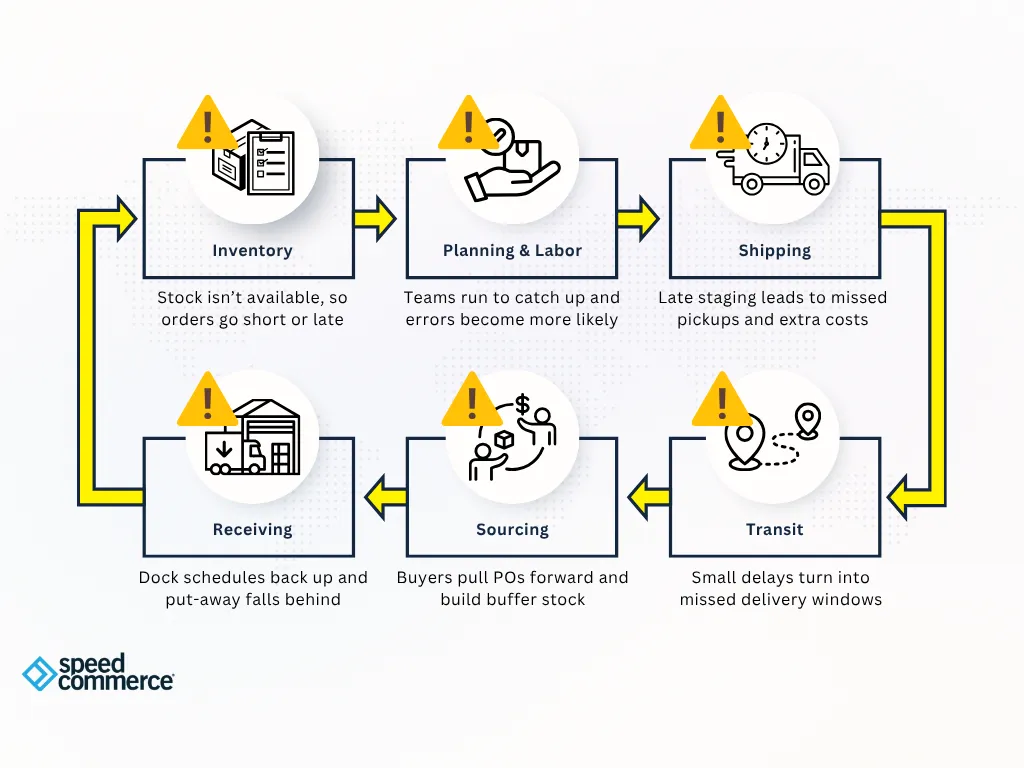
When OTIF misses happen, the impact rarely stays limited to one order. Delays and short shipments can ripple across receiving, inventory, labor planning, shipping, and sourcing.
How Disruptions Spread
In logistics, most teams run on schedules. Warehouses plan labor around expected inbound and outbound volume. Carriers plan pickups and routes around appointment times. Customers plan receiving, shelf replenishment, or production around promised delivery windows.
What Breaks First
When one shipment misses the window, it can start a chain reaction. Dock appointments get bumped. Receiving teams get backed up. Inventory does not get put away on time. The next outbound wave starts late because the product is still in motion or still not available. That is how one delay can push other orders off schedule too.
When this happens repeatedly, it adds variability to the whole operation. Teams start making catch-up moves like rushing picks, paying for faster shipping, or pushing extra volume through the warehouse in a shorter time. That pressure increases the chance of errors and rework, which can create even more delays the next day.
This is where OTIF becomes so useful. It gives you a consistent way to spot whether misses are coming from timing issues, completeness issues, or both. Without that visibility, small disruptions turn into ongoing uncertainty across planning, labor, inventory flow, and shipping across the network.
Should You Measure OTIF By Order, Line, Or Case?
Since there is no single method to measure OTIF, you will need to agree on the method. Whatever you choose will affect your results, so it helps to know what each level means before doing so.
The same shipment can look different depending on how you measure it. For example, one order might have five product lines. If four lines arrive on time and complete but one line is late, the OTIF result could change depending on whether you track it by order or by line.
How does each work?
OTIF Measurement Levels
How OTIF is tracked depends on the level at which orders are measured.
How does each work?
Order-Level OTIF
Order-level OTIF treats the whole order as one pass-or-fail result. If any part of the order is late or incomplete, the full order fails OTIF.
This method is the easiest to understand because it matches how most customers experience delivery. Customers usually care about the complete order arriving when promised, not whether part of it showed up on time.
It is also the strictest method. One small miss can fail the whole order, so order-level OTIF can look lower than line-level or case-level OTIF even when most items are delivered correctly, which is why it is usually best for:
- Simple reporting
- Executive dashboards
- If you want a high-level view of delivery performance
Line-Level OTIF
Line-level OTIF measures OTIF at the line-item level, not the full order. A “line” is one product entry on an order, like 10 units of Item A and 5 units of Item B. Each line is scored separately, so one line can pass while another fails.
This method is useful when orders contain many SKUs or larger quantities because it shows exactly what went wrong. Instead of one order simply showing up as a failure, line-level OTIF can reveal that only one SKU was short, late, or substituted.
It makes problem-solving easier. If the same product line keeps failing, it can point to an inventory accuracy issue, a recurring picking mistake, supplier replenishment delays, or packaging constraints for that specific SKU. This gives a more detailed view because one line can pass while another fails, which is better for:
- Wholesale or B2B orders
- Mixed-SKU shipments
- Teams that want better root-cause analysis
Case-Level OTIF
Case-level OTIF measures performance by case or carton instead of scoring the entire order as one unit. A “case” is the physical unit that gets packed, labeled, shipped, and received, which is how many warehouses and retailers handle products day to day.
This method is common in retail because receiving is often done by scanning or counting cases. If a shipment arrives with missing cases, extra cases, or mislabeled cartons, the delivery can fail even if the overall order quantity looks close. Case-level OTIF helps capture those real receiving outcomes more accurately.
When teams ship and receive in case quantities, case-level measurement helps pinpoint whether issues are coming from packing, labeling, pallet builds, or case count accuracy. It’s why this is best for:
- Retail replenishment
- High-volume distribution
- Operations with strict receiving requirements
Which One Should You Use?
The best option depends on how orders are shipped, received, and reviewed. The best way to approach this is to match the OTIF level to what your customer cares about most.
If customers treat the whole order as one promise, order-level OTIF is usually the clearest. If orders include many SKUs and you want to see which items are driving misses, line-level OTIF is more useful. If shipments are built, scanned, and received by cartons, case-level OTIF will match how performance is actually checked at the dock.
No matter which method you choose, consistency matters more than complexity. OTIF only becomes useful when everyone is measuring it the same way every time.That includes agreeing on:
- What counts as on time
- What counts as in full
- Whether OTIF is measured by order, line, or case
- Which delivery timestamp is used
What Is A Good OTIF Benchmark Rate in 2026?
There is no single OTIF benchmark that fits every business. The table below is a general guide, but actual targets will vary based on how your team defines “on time” and “in full,” along with your industry, shipping model, and customer requirements.
OTIF Targets by Industry
Click any row to see why performance targets vary by sector.
Why It Varies: Tight retailer windows, shelf availability pressure, and strict compliance rules mean even small delays or shortages can trigger chargebacks or lost shelf space.
Why It Varies: Fast delivery promises, parcel carrier variability, and split shipments make consistent OTIF harder, even when warehouse execution is strong.
Why It Varies: Large mixed-SKU orders, dock appointments, and line-item complexity create more opportunities for partial failures than simpler order types.
Why It Varies: Just-in-time operations leave little buffer. The cost of line stoppages and strict timing windows push targets to near-perfect levels.
Why It Varies: Compliance requirements, product integrity controls, and service risk raise expectations. Late or incomplete deliveries can create serious downstream impact.
Why It Varies: Bulky freight, complex routing, and longer lead times make higher OTIF structurally harder to hit, so targets reflect operational realities.
Why It Varies: Shelf-life limits, temperature controls, and retailer deadlines create a narrow window for delivery. Late or partial orders often cannot be accepted.
Why It Varies: Customs clearance, port delays, multiple handoffs, and lane variability introduce uncertainty that lowers achievable benchmarks.
ⓘ This is a general guide only. Actual OTIF targets vary based on how your team defines “on time” and “in full,” along with your industry, shipping model, and customer requirements.
How 10 Leading Companies Use OTIF to Keep Orders on Track
OTIF does not appear the same way in every company. Some use the term openly in supplier programs, while others manage the same idea through fill rate, schedule performance, service-level execution, or inbound compliance. Either way, the goal is the same: get the right product to the right place at the right time and in the right quantity.
The 10 Leading Companies That Use OTIF
Walmart is one of the best-known examples of a company using OTIF in a strict, measurable way. Its supplier program pushes vendors to send the full order by the required delivery date, and missing those standards can lead to penalties.
OTIF connects directly to shelf availability. Late, early, or incomplete shipments can create stock gaps, so Walmart uses scorecards and compliance rules to keep suppliers accurate and on schedule.
To keep the Prime promise, Amazon uses OTIF-style performance controls for its inbound supply chain, especially for first-party vendors shipping against Amazon purchase orders. Once a PO is accepted, vendors are expected to deliver accepted quantities by specified dates to specific delivery points.
Amazon tracks PO timing, fill accuracy, ASN accuracy, and carton content accuracy. Suppliers are judged on shipment data and physical contents, not just what was shipped.
Target manages supplier performance in a way that closely mirrors OTIF. Their compliance updates show fill-rate targets, shipping-window rules, and penalties tied to missed quantities or off-window arrivals.
Target has reported improvements in fill rates and on-time arrivals in earnings materials, which shows these supplier metrics tie directly to broader supply chain performance.
Kraft Heinz made OTIF a core supply chain metric by consolidating separate measures like case-fill rate and on-time delivery into one central OTIF view, giving teams a shared way to judge whether customer orders were being fulfilled correctly.
Kraft Heinz reported a five-point OTIF gain in 2018, crediting the metric for sharpening priorities and improving delivery performance across the business.
P&G’s supplier portal measures end-to-end reliability of supplier materials and uses Supply Schedule Performance to track how well suppliers meet expectations, putting timing and completeness at the center of supplier execution.
Even if P&G’s wording differs from the OTIF acronym, the goal is the same: reduce misses, improve product availability, and keep supply flowing reliably from supplier to customer.
Home Depot reviews supplier performance through on-time delivery, fill rate, labeling, ASN accuracy, routing compliance, and PO compliance, telling suppliers exactly when product should show up, in the right quantity and with the right data.
A scorecard approach helps Home Depot push suppliers toward tighter execution and more dependable inventory flow across its large retail network.
Costco’s compliance guides describe a strong focus on fill rates, labeling accuracy, pallet standards, appointment discipline, and depot fulfillment requirements, expecting suppliers to send bulk-ready, compliant shipments that arrive as planned.
Costco moves high-volume inventory through a membership warehouse format, so missed quantities or poor shipment accuracy can create availability problems fast.
General Mills lists OTIF alongside fill rate, on-shelf availability, outbound service level, forecast accuracy, and inventory KPIs in its own job postings, showing OTIF is part of how the company tracks supply performance internally.
General Mills also recognizes carrier partners with OTIF awards, especially in temperature-controlled freight where late or incomplete deliveries can affect shelf availability and freshness.
Unilever’s job postings reference OTIF delivery for innovations, managing OTIF performance in project delivery, and using OTIF in cross-functional supply and commercial work, treating on-time, in-full execution as a practical performance standard.
For a company selling a huge range of fast-moving consumer products across many markets, missing timing or quantity targets in launches or replenishment can ripple into stock problems and lost sales.
Sam’s Club runs a formal OTIF program for suppliers (similar to Walmart’s) scoring delivery performance and setting clear expectations around arriving on time and in full.
Sam’s Club depends on large-volume, club-format inventory flow. OTIF gives the company a direct way to measure whether suppliers are meeting delivery promises and push better discipline across inbound shipments.
OTIF vs DIFOT vs OTD vs Fill Rate
When you measure your metrics and take a look at performance reports, you might see these operational metrics: OTIF, DIFOT, OTD and Fill Rate. Don’t they mean the same thing? Close, but not really.
OTIF vs DIFOT vs OTD vs Fill Rate
A quick way to understand what each metric measures.
OTIF and DIFOT are often used interchangeably. Both refer to whether an order was delivered on time and in full.
What Causes Low OTIF?
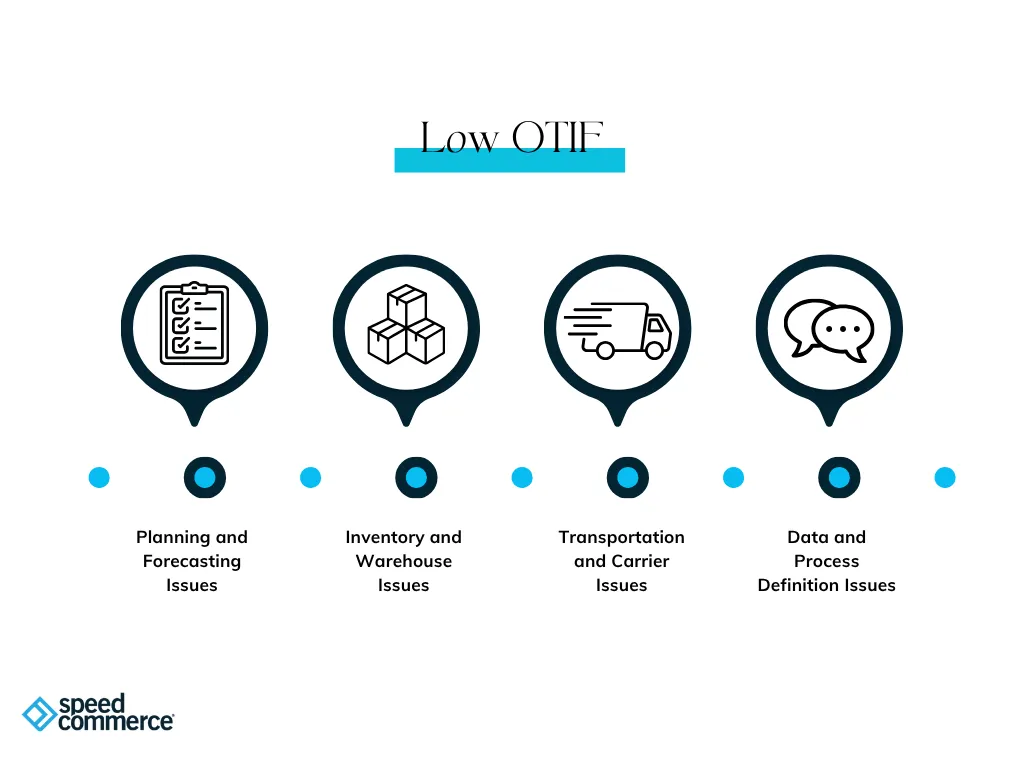
Low OTIF does not come from one issue. The main reasons usually trace back to forecasting problems, inventory gaps, logistics delays, or inconsistent process rules.
Planning and Forecasting Issues
Poor planning is one of the most common OTIF problems. If demand forecasts are off, teams can run short on stock, miss production timing, or release orders too late. When planning is weak, the shipment is already at risk before it even reaches the warehouse.
Inventory and Warehouse Issues
A lot of OTIF misses happen inside the warehouse. Even if transportation runs well, OTIF can still drop when inventory is not managed properly or warehouse execution is inconsistent.
Transportation and Carrier Issues
Transportation is another major driver of low OTIF, especially when delivery windows are tight. Even a complete order can fail OTIF if pickup or delivery timing slips. Among the common causes are dock scheduling and carrier pickup.
Data and Process Definition Issues
A team can think OTIF is low because of operations, but the bigger issue is that teams are using different rules for “on time” or “in full.” McKinsey points out that this causes reporting confusion and makes it harder to fix the real problem. If the rules are not clear, OTIF becomes hard to trust and even harder to improve.
How Can You Improve Your OTIF Scores?
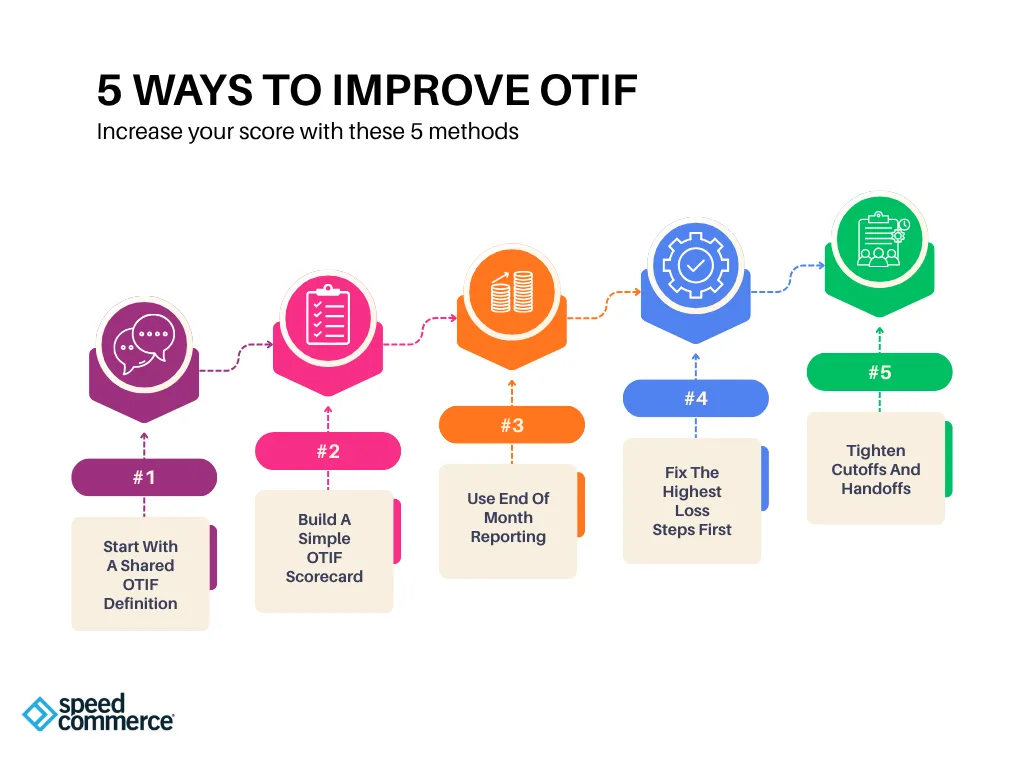
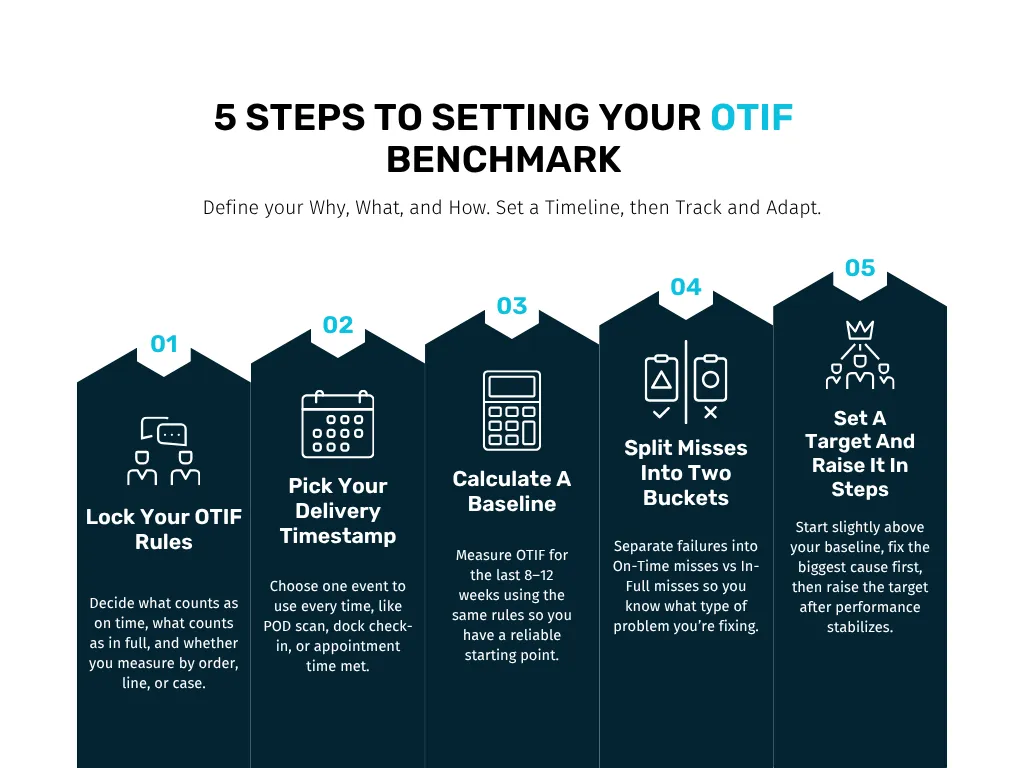
Many teams try to raise OTIF by pushing shipments faster, but that usually does not last if the root cause is unclear. A better approach is to define the metric clearly, track it in a simple way, and fix the parts of the process that cause the most misses.
Start With A Shared OTIF Definition
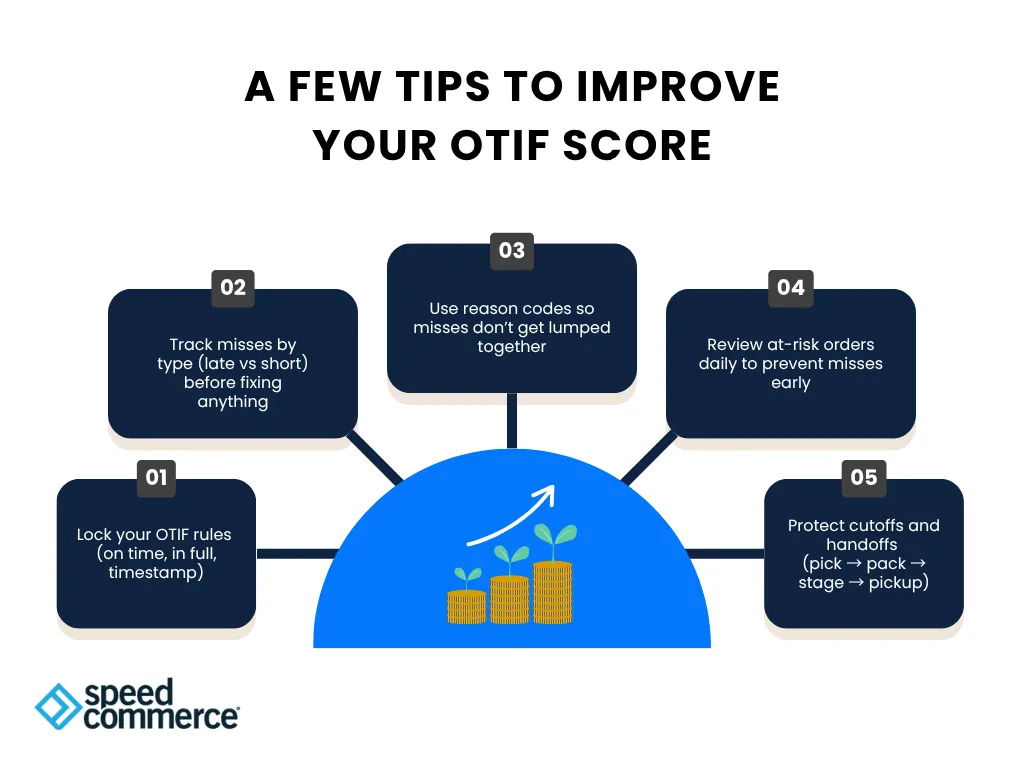
Always make sure everyone uses the same OTIF rules. Having a shared definition gives your team one source of truth, which makes OTIF easier to trust and easier to improve.
This should include what counts as on time, what counts as in full, and what exceptions are allowed. Once those rules are documented, teams can stop debating the number and start fixing the reasons behind missed orders.
Build A Simple OTIF Scorecard
Your scorecard should show your OTIF rate, total orders, failed orders, and the main reasons for misses. When this is tracked weekly, teams can spot patterns sooner, like repeated late pickups or short shipments from the same product group.
Start with a small set of numbers that show what happened and why it happened. Once that habit is in place, you can add more detail later if needed.
Use Exception Management Instead Of End Of Month Reporting
End of month reporting tells you what already went wrong. Exception management, on the other hand, is different because it focuses on orders that are at risk before they fail OTIF.
This way it helps teams act earlier, reduce preventable misses, and protect service levels before the problem gets bigger. It also gives teams better reason codes because the issue is captured while it is still fresh.
Fix The Highest Loss Steps First
Don’t try to fix every OTIF problem at the same time. The fastest progress usually comes from finding the step that causes the most misses and working on that first. When you focus on the biggest source of loss, the OTIF score usually improves faster.
Start by reviewing failed orders and grouping them by cause. If one issue keeps showing up, assign ownership and make one process change at a time. Small improvements at the highest-loss step can move OTIF more than broad changes across the whole operation.
Tighten Cutoffs And Handoffs
A lot of OTIF misses happen in the handoff between steps, like when an order is picked but not staged on time, or staged but not picked up on schedule. Tightening cutoffs and handoffs means setting clear internal deadlines for each stage, then protecting them.
For example, if an order must hit a delivery window, the warehouse needs a realistic cut time that accounts for picking, packing, labeling, staging, and carrier pickup time.
This helps reduce last-minute rush work and makes it easier to spot bottlenecks. If staging is always late, you know where to focus. If pickups are being missed, you can adjust carrier schedules or build more buffer into the plan.
Built to Deliver On Time, In Full
Every Time.
If your business is working to improve delivery reliability, you’ll need a 3PL partner that understands how important OTIF is to day-to-day fulfillment. Speed Commerce is built around the disciplines that drive high OTIF: clear rules, consistent execution, and real-time visibility across every order.
Get a Quote →Frequently Asked Questions About OTIF
OTIF stands for On Time, In Full. It checks whether an order arrived by the agreed delivery time and with the correct items and quantities.
OTIF is usually calculated as: OTIF (%) = (Orders Delivered On Time and In Full ÷ Total Orders) × 100. An order must meet both conditions to count.
In most supply chain settings, there is no major difference. OTIF and DIFOT usually mean the same thing, just written in a different order.
It is the ideal target, but it is not always realistic in day-to-day operations. Many teams set a strong target range first, then improve over time.
A good OTIF target depends on the business type, customer requirements, and how OTIF is defined. Many teams aim for a range in the low-to-mid 90s, then adjust based on the operation.
It depends on customer or receiving rules. Some companies accept early deliveries, while others treat early arrivals as misses if they fall outside the agreed delivery window.
Both methods are used. Order-level OTIF is simpler, while line-level OTIF gives more detail for mixed-SKU or large wholesale orders.
Low OTIF is usually caused by a mix of planning issues, inventory gaps, warehouse errors, transportation delays, or unclear OTIF rules across teams.
OTIF should be reviewed regularly, not just at the end of the month. Weekly reviews are common, and many teams also monitor at-risk orders during the week.
Yes, in many cases. OTIF can improve through better planning, tighter warehouse execution, clearer delivery rules, and faster issue tracking, not just faster shipping.

Speed Commerce Resources
Fulfillment Guides Worth Reading
Operations, shipping, and supply chain. Explained for growing brands.

eCommerce Fulfillment
eCommerce fulfillment is the end-to-end process of receiving inventory, picking and packing orders, shipping them, and handling returns.

Pick and Pack Fulfillment Services
As order volume grows, pick and pack gets harder to manage without clear warehouse rules. The right workflow improves speed, accuracy, and packing consistency.

Crowdfunding Fulfillment
From backer surveys to customs and replacements, crowdfunding fulfillment has its own rules. Learn what usually goes wrong and how to plan ahead.

Freight Shipping Quotes
Small freight details can create big pricing swings. See what quotes include, why re-rates happen, and how to estimate costs more accurately before you book.

What Is a Backorder?
When inventory runs out, your next move matters. We explain backorder vs. out of stock, the pros and risks of accepting backorders, and how brands protect sales.

OTIF (On Time, In Full)
One of the most important supply chain metrics for fulfillment reliability. Explore how it works, what causes misses, and how teams improve scores over time.

East Coast 3PL Services
An East Coast 3PL helps brands ship closer to customers across the Northeast, Mid-Atlantic, and Southeast for faster fulfillment and smarter inventory placement.